New research led by scientists at UC San Diego’s Scripps Institution of Oceanography finds that the travel time of underwater sounds traveling across the Arctic Ocean can be used to precisely measure ocean temperature under the region’s sea ice, providing precious data on temperature variability in a rapidly changing environment that is remote and difficult to access.
New research led by scientists at UC San Diego’s Scripps Institution of Oceanography finds that the travel time of underwater sounds traveling across the Arctic Ocean can be used to precisely measure ocean temperature under the region’s sea ice, providing precious data on temperature variability in a rapidly changing environment that is remote and difficult to access. The technique, known as ocean acoustic thermometry, was originally developed by the late Walter Munk and Peter Worcester at Scripps and Carl Wunsch at the Massachusetts Institute of Technology.
The basic principle leveraged by acoustic thermometry is that sound travels faster in warmer water and slower in colder water. The technique uses this relationship to infer the temperature of the water the acoustic signal passes through by measuring the time it takes the sound to travel from one point to another. The researchers tested the method during the 2019-2020 Arctic field season with the joint US-Norwegian Coordinated Arctic Acoustic Thermometry Experiment (CAATEX). The team used six bottom-anchored moorings across a roughly 2,600-kilometer (1,600-mile) path in the Arctic Ocean to transmit and measure acoustic signals every three days. The moorings spanned the Arctic Ocean, from north of Alaska in the west to north of Svalbard in the east, and remained in place for one year.
The experiment aimed to test whether this might be a viable way to measure Arctic Ocean temperature year-round, or if challenges such as the scattering of the sound by the rough undersides of sea ice might render the signals undetectable or impossible to decipher.
Read More at: University of California San Diego
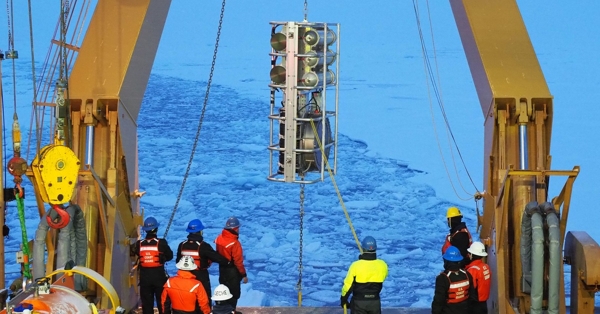
An acoustic sound source manufactured at the Marine Science Development Center for Scripps researcher Matthew Dzieciuch being deployed in the Arctic Ocean from the U.S. Coast Guard Icebreaker Healy. Acoustic systems like these are uniquely able to monitor under the ice where satellites are compromised, and provide an unprecedented look at the changing Arctic environment. (Photo Credit: Lee Freitag/WHOI)