

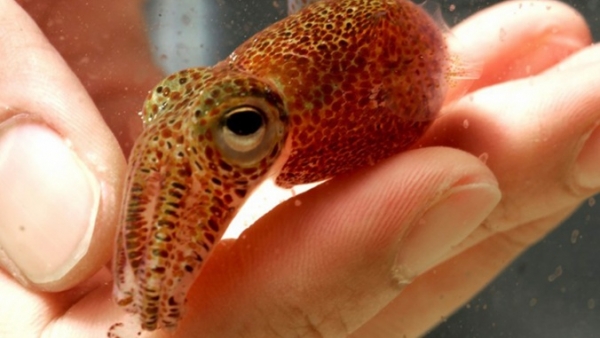
Researchers have found there is a bacterial protein “key” that allows the Hawaiian bobtail squid to develop a healthy body and its bioluminescent “glow.”
Researchers have found there is a bacterial protein “key” that allows the Hawaiian bobtail squid to develop a healthy body and its bioluminescent “glow.” While researchers have long known the squid recruits Vibrio fischeri from the ocean to provide bioluminescent camouflage, a University of Hawaiʻi at Mānoa study revealed that the benefit of the partnership extends far beyond light-production: the bacteria were found to play a vital role in the healthy development of the squid.
“Our recent work revealed that in order to develop properly, the squid host requires a protein provided by its bacterial symbiont,” said Jill (Kuwabara) Smith, lead author of the study, who was a postdoctoral researcher at the Pacific Biosciences Research Center (PBRC) in the UH Mānoa School of Ocean and Earth Science and Technology (SOEST) at the time of this research. “This was very surprising, but given that the work we do with this symbiosis model is always pioneering, just about every new finding is a surprise!”
Read more at: University of Hawaii
Hawaiian bobtail squid. (Photo Credit: Margaret McFall-Ngai and Edward Ruby)


