

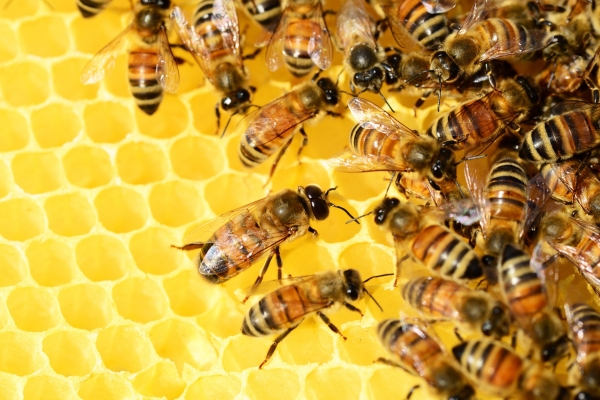
A recent study shows that heat causes a sharp hormonal spike in isolated honey bees, but social interactions and a key pheromone help prevent this stress response, revealing how bees stay resilient in a warming world.
A recent study shows that heat causes a sharp hormonal spike in isolated honey bees, but social interactions and a key pheromone help prevent this stress response, revealing how bees stay resilient in a warming world.
Heat can change a honey bee’s hormone levels, but only if the bee is alone. New research from MSU entomologist Zachary Huang shows that isolated honey bees experience a rapid hormonal rise when exposed to high temperatures, while bees kept in groups stay stable. The discovery highlights how social conditions and chemical signals shape bees’ ability to withstand environmental stress.
To test this, Huang and collaborator Thomas Rachman, a high school student when the experiments were conducted, exposed bees to one hour of heat at 40°C. They compared the effects of heat on solitary bees and on groups of 25, measuring how much juvenile hormone (JH) each produced under the same conditions. Juvenile hormones are present in all insects and are named for their role in keeping larvae “juvenile,” preventing them from molting into adults. In adult honey bees, however, JH plays another role. It also helps pace behavioral shifts, with nurse bees showing lower levels of the hormone and foragers showing the highest levels.
Read More at: Michigan State University
Photo Credit: PollyDot via Pixabay


