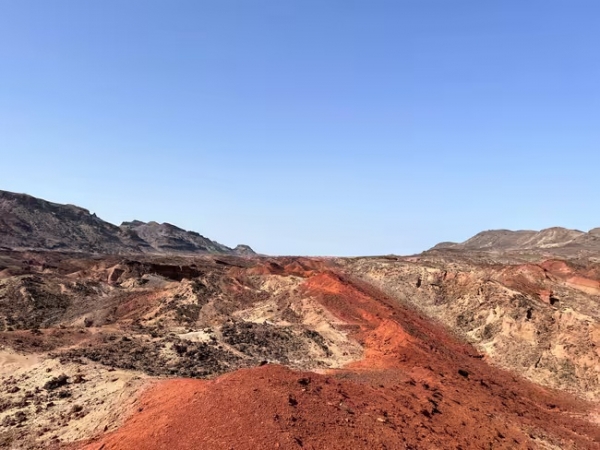
Eastern Africa’s Turkana Rift is both a hotbed for fossil discoveries of our earliest ancestors and a literal hotbed of volcanic activity caused by shifting tectonic plates.
Eastern Africa’s Turkana Rift is both a hotbed for fossil discoveries of our earliest ancestors and a literal hotbed of volcanic activity caused by shifting tectonic plates. Now researchers have found that Earth’s underlying crust in the region has been significantly thinned, presaging Africa’s eventual breakup—and with that finding, the researchers offer a new perspective on how Turkana’s world-famous fossil record of human evolution came to be.
The findings were published in Nature Communications.
Scientists have long been fascinated by the Turkana Rift, a 500-kilometer-wide, low-lying region that spans Kenya and Ethiopia. This rift is part of the larger East African Rift System, which runs from the Afar Depression in northeastern Ethiopia to Mozambique in the south, with the African tectonic plate on one side and the Arabian and Somali plates on the other. At the Turkana Rift, the African and Somali plates are drifting apart at a rate of about 4.7 millimeters per year. In the process, known as rifting, Earth’s crust is stretched horizontally, causing it to buckle and fracture, thus releasing magma from deep below.
Not every rifting episode ends in continental breakup. The Turkana Rift, however, appears destined for that fate.
Read More: Columbia Climate School
Image: Late Miocene fossil-bearing strata of Lothagam in West Turkana. Photo: Christian Rowan