Experimental increases in CO₂ stimulated plant growth are facilitated by re-distributed root systems to extract nutrient resources more efficiently.
Experimental increases in CO₂ stimulated plant growth are facilitated by re-distributed root systems to extract nutrient resources more efficiently.
Tropical forests are one of the planet's most important carbon sinks – often also called "the lungs of our Earth". But their future in a high-CO₂ world remains uncertain. New research from the Central Amazon with researchers from the University of Vienna, the Technical University of Munich, and the National Institute for Amazon Research, Manaus, suggests even small understory trees may initially buffer climate change more strongly. But their long-term capacity to store carbon could be restricted by nutrient availability – highlighting the vulnerability of these ecosystems under future climate conditions. The results have been published in Nature Communications.
The Amazon forest is one of the tipping elements in the global water and climate system, storing and absorbing huge amounts of CO₂. Still, it is not clear, to which extent trees can increase growth, with more CO₂ in the atmosphere. "Around 60 percent of the Amazon forest grows on old and highly weathered soils, which are already quite depleted in mineral nutrients, such as phosphorus", says Lucia Fuchslueger, researcher at CeMESS, University of Vienna, and co-lead-author of the new study. "Low levels of phosphorus could make it difficult for the forest to grow even more and make use of the extra CO₂ in the atmosphere", she adds. However, Amazonian trees have developed highly efficient internal nutrient cycles that could allow them to gain access to even more nutrients. For example, they are withdrawing nutrients from their leaves before they drop them. Also, rapid organic matter decomposition on the ground provides additional nutrients, but it is not clear if this system can get any more efficient. So far, there has been no experimental evidence from in situ forest experiments.
Read More: University of Vienna
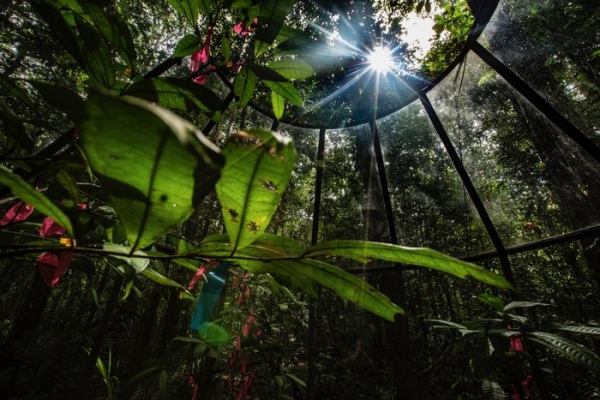
Image: Fig. 1: Open-top chamber for the Experiment in the Central Amazon. (Credit: Dado Galdieri)