

A violent volcanic eruption in the South Pacific has revealed a surprising natural mechanism that could potentially help slow global warming.
A violent volcanic eruption in the South Pacific has revealed a surprising natural mechanism that could potentially help slow global warming. The finding provides entirely new insights into atmospheric chemistry and may inspire new methods to remove methane emissions from the air.
TWhen the submarine volcano Hunga Tonga–Hunga Ha’apai in the South Pacific erupted in January 2022, it was not only one of the most violent volcanic eruptions in modern times. The volcano also did something completely unexpected: it helped clean up some of the methane pollution it released. This phenomenon could potentially be key to how humans can slow global warming.
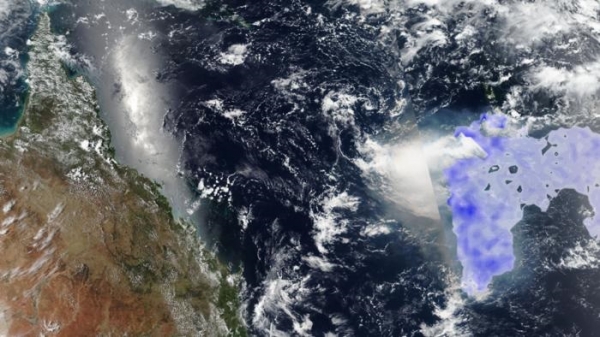
Using advanced satellite measurements, researchers observed unusually high concentrations of formaldehyde in the massive volcanic plume following the eruption. This was crucial evidence: when methane is destroyed in the atmosphere, formaldehyde forms as a short-lived intermediate.
Read more at: University of Copenhagen
Satellite image using the VIIRS satellite on 16 January 2022, 13:30 UTC, showing in blue the cloud of formaldehyde measured by TROPOMI. To the left is the Australian coast of Queensland. Source: van Herpen et al. (2026) (Photo Credit: van Herpen et al. (2026))


