Some Alaska cruises are skipping a popular excursion to Tracy Arm Fjord this year after a landslide-generated tsunami barreled through the narrow channel during peak season last August.
Some Alaska cruises are skipping a popular excursion to Tracy Arm Fjord this year after a landslide-generated tsunami barreled through the narrow channel during peak season last August. A new analysis of the event from researchers at the University of Calgary and the University of Washington, published May 6 in Science, describes how glacial retreat caused by global warming primed the fjord for the colossal wave and what, if any, warning signs preceded it.
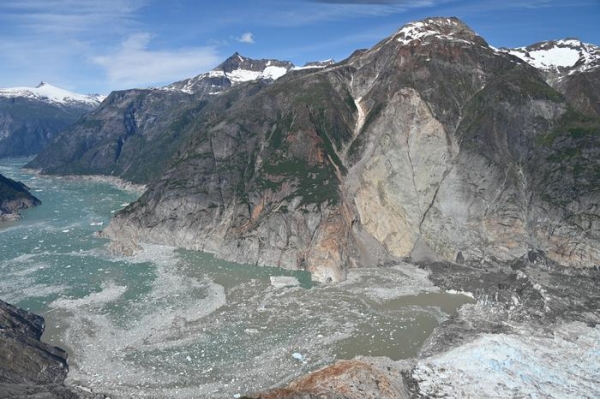
At 5:26 a.m. on Aug. 10, 2025, a piece of the mountainside one kilometer tall and 200 meters thick collapsed into the Tracy Arm Fjord, a scenic waterway south of Juneau. Rock crashed into the water, taking with it chunks of the South Sawyer glacier and producing a 481-meter high tsunami so powerful that it scraped surrounding hillsides bare.
The event would have been “unsurvivable for any ship of any size,” said co-author Gerard Roe, a UW professor of Earth and space sciences, but fortunately the tsunami occurred too early for tours and no one was harmed.
Read More: University of Washington
Image: Oblique aerial photo of the August 10, 2025 landslide, terminus of South Sawyer Glacier, and Tracy Arm taken from across the fjord during a U.S. Geological Survey field reconnaissance overflight on August 13, 2025.
Note the trimline along the far side of the fjord, caused by the tsunami stripping the walls of vegetations. View direction is approximately north. (Credit: Photo by Cyrus Read/U.S. Geological Survey)