Artificial intelligence can dramatically speed up the painstaking work of tracking wildlife with remote cameras, cutting analysis time from months or even a year to just days while producing nearly the same scientific conclusions as humans.
Artificial intelligence can dramatically speed up the painstaking work of tracking wildlife with remote cameras, cutting analysis time from months or even a year to just days while producing nearly the same scientific conclusions as humans.
That’s according to a new study led by researchers at Washington State University and Google, published in the Journal of Applied Ecology. The team tested whether a fully automated AI system could replace humans in processing hundreds of thousands to millions of camera trap images collected in Washington, Montana’s Glacier National Park, and Guatemala’s Maya Biosphere Reserve.
They found that, for most species, models built from AI-identified images closely matched those produced by human experts. Across key measures such as where animals occur and what environmental factors influence them, the results aligned in roughly 85–90% of cases, with limited divergence for rare or difficult-to-identify species.
Read More: Washington State University
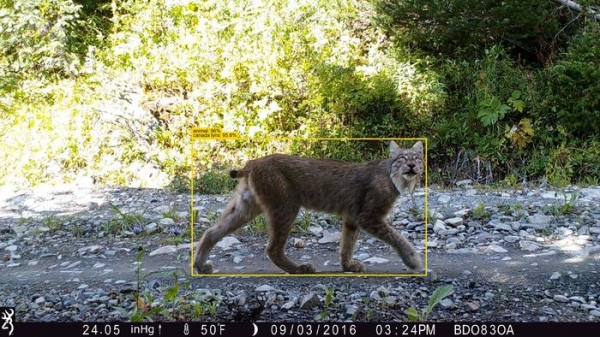
Image: SpeciesNet's AI prediction can be seen on an image of a lynx. (Credit: Mammal Spatial Ecology and Conservation Lab)