A Dartmouth study shows that annual rainfall in much of the world has consolidated over the past four decades into heavier storms with longer dry periods in between.
A Dartmouth study shows that annual rainfall in much of the world has consolidated over the past four decades into heavier storms with longer dry periods in between.
“It doesn’t matter where you are, more consolidated rainfall means less water is available for the land. We show that this phenomenon is consistent worldwide, what physically accounts for it, and what we should expect going forward,” says Justin Mankin, the study’s senior author and an associate professor of geography.
“Rainfall concentration is almost as important to land wetness as how much rainfall you get in a year,” says first author Corey Lesk, who led the study as a Neukom Postdoctoral Fellow in Mankin’s Climate Modeling and Impacts Group.
Read More at: Dartmouth College
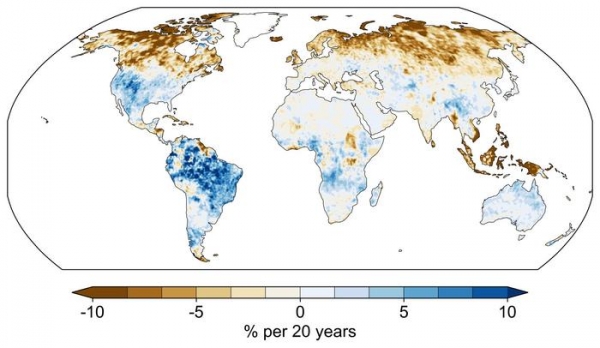
Dartmouth researchers used an economic tool called a Gini coefficient that typically measures wealth inequality to gauge how evenly or unevenly precipitation fell each year from 1980-2022. They found that annual rainfall has become more concentrated (blue scale) for most of the world, regardless of whether the local climate is wet or dry. The western United States saw among the highest levels of rain consolidation, with yearly rainfall for the Rocky Mountains becoming 20% more concentrated. Conversely, precipitation in the Arctic, Northern Europe, and Canada became less concentrated (brown scale) as their warming climates result in more snow and rain year-round. (Photo Credit: Corey Lesk and Justin Mankin)