Ghost forests, the cemetery-like groupings of dead trees killed by saltwater intrusion, have become haunting symbols of sea level rise overtaking land along the Mid-Atlantic coast.
Ghost forests, the cemetery-like groupings of dead trees killed by saltwater intrusion, have become haunting symbols of sea level rise overtaking land along the Mid-Atlantic coast. But a new study in Nature Sustainability led by William & Mary’s Batten School & VIMS points to even more dramatic land losses in the region’s coastal farmlands, where the rate of marsh encroachment is happening nearly twice as fast.
Using satellite data spanning decades as well as recent field measurements, the study’s authors found that between 1984 and 2022 approximately 25,000 acres of farmland was lost to sea level rise in the Chesapeake and Delaware Bay watersheds, despite preventative measures taken by local farmers.
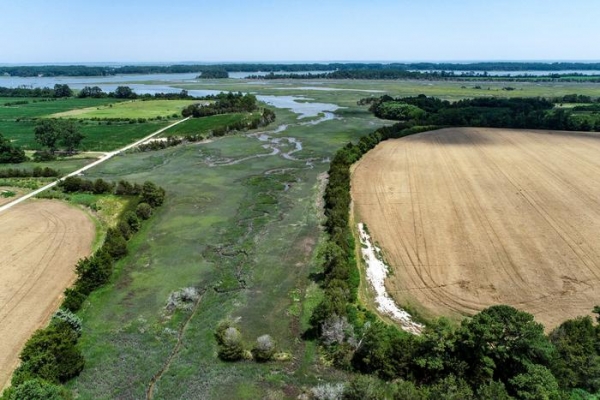
“There's this assumption that we'll never let sea level rise consume farmland, that people will protect valuable land. And it's just wrong,” said Matt Kirwan, co-author and professor of marine science at the Batten School of Coastal & Marine Sciences & VIMS. “We found lots of examples where small levees were built at the edges of fields to prevent saltwater intrusion, but they only slowed down the loss. They couldn’t stop it.”
Read More at: Virginia Institute of Marine Science
Aerial view of a tidal marsh winding between two farm fields on Maryland's Eastern Shore, with a white salt patch visible on the right-hand field and a line of trees marking a levee between the marsh and farmland. (Photo Credit: Grace Molino)