

The removal of CO₂ from the atmosphere is considered an important tool in the fight against climate change – but has so far been an energy-intensive and expensive process.
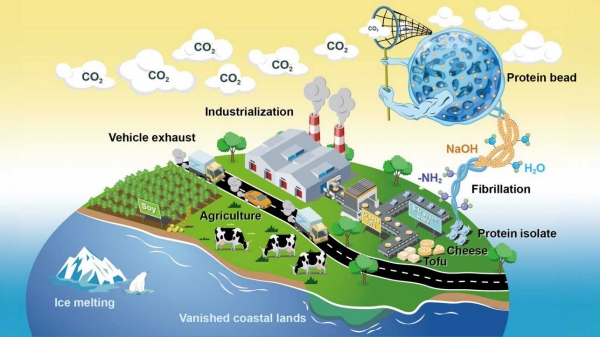
The removal of CO₂ from the atmosphere is considered an important tool in the fight against climate change – but has so far been an energy-intensive and expensive process. Now, researchers have developed a new method that efficiently binds carbon dioxide and releases it again using only a small amount of energy. The starting materials are provided by waste products from dairy and soy processing.
In order to stabilise global warming at less than 1.5°C in the long term, there is a need not only for a drastic reduction in greenhouse gas emissions but also for technologies to remove and store hundreds of billions of tonnes of carbon dioxide (CO2) from the atmosphere. This is also the underlying basis of the scenarios set out in the latest Assessment Report from the Intergovernmental Panel on Climate Change (IPCC).
For years, research groups and start-ups have therefore been working on ways to remove CO2 directly from the air – a process known as “direct air capture”. The company Climeworks, which was founded as an ETH spin-off in 2009, is one of the world’s first commercial providers of DAC. To this day, however, the direct removal of CO2 from the air remains an energy-intensive and expensive process.
Read More: ETH Zurich
Image: The new direct air capture method: food waste from cheese and tofu production is processed into small beads that can capture CO2 (Image: Mezzenga Lab / ETH Zurich)


