Rainfall history is just as critical to predicting air pollution as where the air came from, a team led by University of Michigan Engineering researchers has discovered, in collaboration with scientists at the Appalachian Mountain Club and Plymouth State University.
Rainfall history is just as critical to predicting air pollution as where the air came from, a team led by University of Michigan Engineering researchers has discovered, in collaboration with scientists at the Appalachian Mountain Club and Plymouth State University.
The findings give meteorologists a physical benchmark to improve simulations that predict changes in pollution levels over complex terrains. It also shows how air pollution can be deposited in sensitive mountain environments, with downstream effects for waterways fed from the mountains.
The research team analyzed cloud and rainwater samples collected over 19 summers (1996-2014) at the top of Mount Washington, New Hampshire, by the Appalachian Mountain Club. The rare, long-term sample series contained markers of human pollution and rainout—how much it rained before the air mass arrived in New Hampshire.
“Mount Washington is the tallest peak in the northeast and experiences extreme weather. This isolated, remote region provides unique data that helps us study how pollution comes into the area,” said Lauren Richards, an undergraduate student at U-M majoring in climate and meteorology and lead author of the study published in Earth and Space Science.
Read more at: University of Michigan
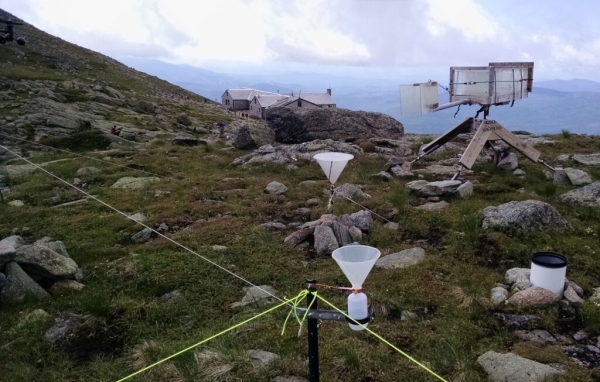
A cloud water collection system set up outside of the Lakes of the Clouds hut, maintained by the Appalachian Mountain Club. As clouds pass over the mountain, water condenses on the strings and filters into collection vials. Cloud and rainwater samples collected here over 19 summers helped researchers understand how upwind rain impacts air quality. (Photo credit: Adriana Bailey, Michigan Engineering)