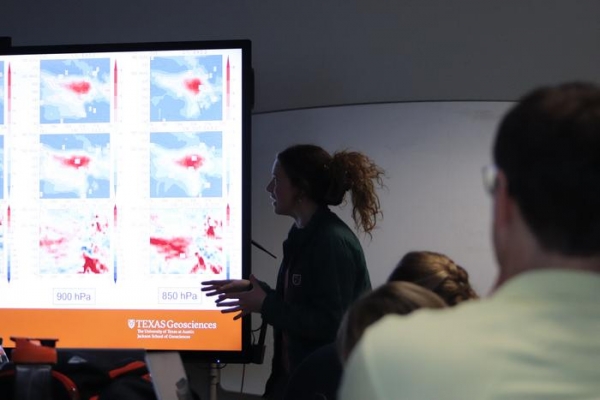
Last fall, a group of 12 students huddled around their laptops in a dark room in the Jackson School of Geosciences building.
Last fall, a group of 12 students huddled around their laptops in a dark room in the Jackson School of Geosciences building. Their screens, which displayed colorful swirls over a map of Central Texas, emitted a jolt of color into the space. Most of them had never done climate modeling before. And as residents of Central Texas, their first project hit close to home. They were all dedicated to modeling the same extreme weather event: the July 4, 2025 rainstorm that had so utterly devastated the Texas Hill Country only a few months prior.
This storm caused catastrophic flooding that killed at least 139 people, 37 of whom were children. Even for people who hadn’t lost a friend or family member in the flood, this weather event loomed large in the students’ memory, and the project carried emotional weight.
When the assignment was announced, Elizabeth Chapa, who at the time was a third-year climate system science major, immediately called her parents to tell them what she’d be working on.
Read More at: University of Texas at Austin
Elizabeth Chapa presents her final project to the GEO 347G class in December 2025. Her instructor, Research Scientist Edward Vizy, is seen in the foreground. (Photo Credit: Jackson School of Geosciences)