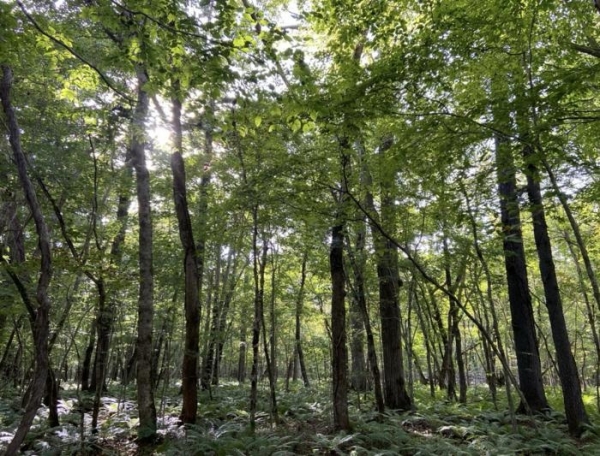
Forests are shaped by light competition. The trees that grow the tallest have access to the most sunlight, blocking the rays and rendering the shaded space around them inhospitable to shorter trees below.
Forests are shaped by light competition. The trees that grow the tallest have access to the most sunlight, blocking the rays and rendering the shaded space around them inhospitable to shorter trees below. In this stem exclusion phase of forest succession, the shorter trees often die. Yet scientists have observed that in old growth forests, trees of vastly different sizes successfully coexist, proving that reaching the top of the canopy is not the sole winning strategy for survival in a forest environment.
The height diversity of trees in mature forests indicates that light competition and species coexistence can balance out in forest succession. To understand how, quantifying light competition among trees is essential, but the complex architectural structures of natural forests and individual crowns have hindered rigorous scientific evaluation. A team of researchers from Kyoto University resolved to take on the challenge and solve this mystery.
"The competition for light among trees is frequently referred to as an evolutionary arms race, but trees of vastly different sizes successfully coexist in mature forests," says first author Yusuke Onoda. "We became interested in this paradox."
Read More: Kyoto University
Image: A lush green forest, one of the study sites used in this study. While appearing peaceful at first glance, the forest is a fierce battleground for survival among trees. (Credit: KyotoU / Yusuke Onoda)