

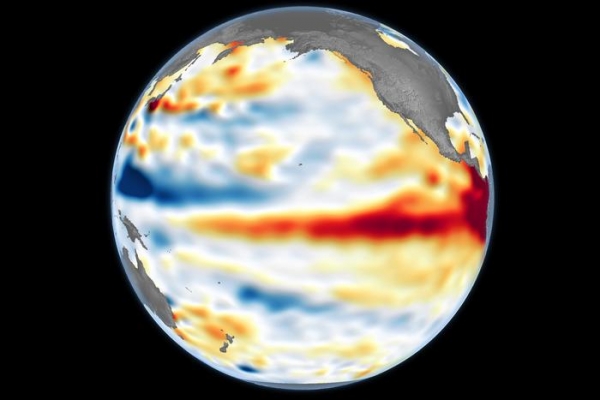
With an anticipated “super” El Niño looming, a new study led by UC San Diego’s Scripps Institution of Oceanography considers whether society could use a weather-altering technique as a tool to mitigate the floods, extreme heat and other events that El Niño would bring.
With an anticipated “super” El Niño looming, a new study led by UC San Diego’s Scripps Institution of Oceanography considers whether society could use a weather-altering technique as a tool to mitigate the floods, extreme heat and other events that El Niño would bring.
An attempted real-world field test could lead to disastrous unintended consequences but the “Black Summer” bushfires that scorched Australia in 2019 and 2020 served as a “natural experiment.” The smoke that wafted into the atmosphere was filled with reflective, cloud interacting aerosols akin to those used in a geoengineering method called marine cloud brightening.
Previous research by one of the study co-authors found that the smoke-brightened clouds throughout the southeastern Pacific Ocean appeared to play a key role in creating global La Niña-like weather patterns. The effect was compelling enough that the team led by Scripps Oceanography researchers Kate Ricke and Jessica Wan used a seasonal forecasting model to investigate what would have happened if a similar event had occurred before a “super El Niño” instead. The results suggest that this might be an instance where geoengineering is worthy of serious consideration, the authors said.
Read More: University of California - San Diego
Image: El Niño on June 8, 2026 as represented by sea surface height. Image: NASA (Credit: NASA)


