

While the world watches the Pacific for signs of a possible "Super El Niño," new research suggests another tropical ocean may hold important clues to future climate extremes.
While the world watches the Pacific for signs of a possible "Super El Niño," new research suggests another tropical ocean may hold important clues to future climate extremes. Scientists have discovered that temperature patterns in the Indian Ocean can influence prolonged winter dry spells in the Eastern Mediterranean months in advance by reshaping large-scale atmospheric circulation. The findings reveal how distant ocean conditions can affect weather thousands of kilometers away and could improve seasonal forecasting of drought risk in one of the world's most water-stressed regions.
Research reveals that distant ocean temperatures can help predict prolonged winter dry spells in the Eastern Mediterranean months in advance.
As scientists around the world closely monitor the possible development of a powerful "Super El Niño," a new study suggests that another tropical ocean deserves equal attention. Researchers have found that temperature changes in the Indian Ocean can significantly influence winter weather thousands of kilometers away in the Eastern Mediterranean, offering new opportunities to predict damaging dry spells months before they occur.
The study, published in Atmospheric Research, was carried out by Phd. Student Victor Murphy and Dr. Assaf Hochman of the Institute of Earth Sciences at the Hebrew University of Jerusalem and Dr. Sigalit Berkovic of the Israel Institute for Biological Research. The researchers investigated how the Indian Ocean Dipole (IOD), a recurring pattern of warming and cooling across the tropical Indian Ocean, affects prolonged winter dry spells in the Levant, one of the world's most water-stressed regions.
Read More: The Hebrew University of Jerusalem
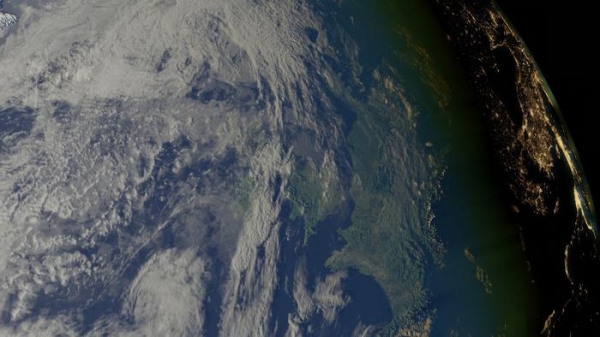
Image: 3D composite of Nasa open source images being built on to a wiremesh frame that is a representative form of Earth, with clouds. (Creidt: Victor Murphy)


