

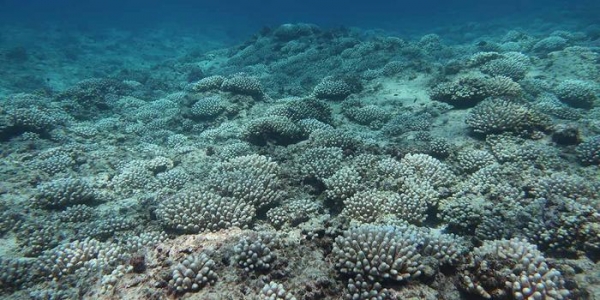
Since the first major bleaching event in 1996, Hawaiian corals have been subject to increasing heat stress and more prevalent bleaching events.
Since the first major bleaching event in 1996, Hawaiian corals have been subject to increasing heat stress and more prevalent bleaching events. New research from oceanographers at the University of Hawai‘i at Mānoa used high-resolution modeling that includes small-scale processes to examine projected heat stress on coral reefs over the 21st century. Comparing this heat stress to previous estimates of the rate at which corals may adapt to changing conditions, the authors found that Hawaiian corals have the possibility of adapting to future heat stress, even under a high emissions scenario. Their results were published recently in Scientific Reports.
“Our research shows that Hawaiian corals may be exposed to unprecedented human-induced heat stress in the coming decades,” said Kate Feloy, lead author of the study, who conducted this work as part of her doctoral research in the Department of Oceanography in the UH Mānoa School of Ocean and Earth Science and Technology (SOEST). “However, our results also provide some surprising hope that Hawaiian corals may be able to adapt to increasing temperatures.”
Feloy and co-authors used high-resolution ocean simulations, run under three different climate emissions scenarios. The modeling approach accounts for small-scale processes and can reveal important spatial patterns in local warming. This is the first time this type of high-resolution climate projections have been used to assess future heat stress around the Main Hawaiian Islands.
Read More at: University of Hawaii at Manoa
Bleached Acropora corals at eastern French Frigate Shoals. (Photo Credit: Morgan Winston / NOAA Fisheries)


