

Their study, published in the journal NPJ Biofilms and Microbiomes, paves the way for the development of inoculants that can be used in agriculture.
Their study, published in the journal NPJ Biofilms and Microbiomes, paves the way for the development of inoculants that can be used in agriculture.
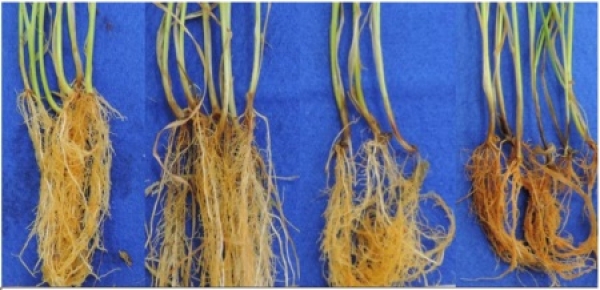
“We selected three bacteria from a group we had isolated in a previous study that showed the greatest potential to improve plant growth and exert an antagonistic effect against the pathogen. When we grew wheat in soil containing the bacteria and the pathogen, the fungus Bipolaris sorokiniana, we observed a 60% reduction in disease symptoms compared to treatments with only the pathogen in the soil,” says Caroline Sayuri Nishisaka, who conducted the research as part of her doctoral studies with a FAPESP scholarship at the EMBRAPA Environment unit in Jaguariúna.
The study also involved researchers from the Center for Nuclear Energy in Agriculture (CENA) and the Luiz de Queiroz College of Agriculture (ESALQ), both at USP. The research is part of two projects supported by FAPESP (20/00469-2 and 25/11610-1).
Read More: Fundação de Amparo à Pesquisa do Estado de São Paulo
Lesions caused by B. sorokiniana on roots: from left to right, plants without symptoms and with mild, moderate, and severe lesions (Photo Credit: Caroline Sayuri Nishikata/EMBRAPA)


