

As one moves north, Maine’s kelp forests are being overtaken by dense mats of carpet-like turf algae.
As one moves north, Maine’s kelp forests are being overtaken by dense mats of carpet-like turf algae. The steady decline of kelp, and transition into this new state, is altering the ecosystem all the way down to the microbial level, according to a new study in PNAS from Bigelow Laboratory for Ocean Sciences.
The research shows that microbes play an important role in kelp forests — a role that is different on turf-dominated reefs, where the types of microbes present, and the chemical compounds they use and produce, are fundamentally different. That finding highlights how the loss of foundation species due to environmental change cascades through all levels of the ecosystem, altering basic biochemical processes and species relationships.
“We’ve shown in the past that the loss of kelp leads to changes in the ecology and habitat value of our coastal reefs; we now show that this loss ripples out, all the way down to microbial scales,” said Senior Research Scientist Douglas Rasher, the study’s senior author. “The relationships we’re unraveling between these underwater forests, their microbial members, and the chemical landscapes they collectively create are invisible to the naked eye but may be critical to kelp forest functioning and resilience in this warming world.”
Read More: Bigelow Laboratory for Ocean Sciences
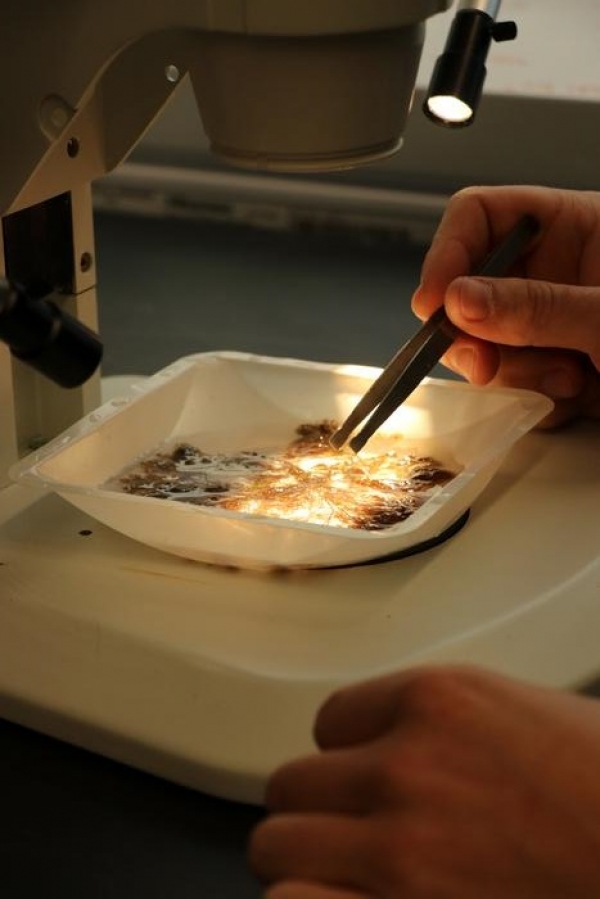
Lead author Shane Farrell examines a sample of algae collected on the Maine coast under a microscope to study the microbial community. (Photo Credit: Bigelow Laboratory for Ocean Sciences)


