

Isotopes of atmospheric water leave fingerprints that can improve weather modeling.
Isotopes of atmospheric water leave fingerprints that can improve weather modeling.
Weather forecasts rely on many and various kinds of data, including temperature, humidity and wind data. For the first time, researchers including those at the University of Tokyo demonstrate that a long-theorized improvement to weather models by adding data on water isotopes in the atmosphere does in fact work. They showed that incorporating satellite measurements of water vapor isotopes into weather models improves forecasts of atmospheric conditions for up to five days, including better predictions of heavy rainfall in many regions.
Isotopes are alternate forms of atoms, where the number of neutrons is different to the number found in the typical atom. This means that isotopes are often heavier than their atomic counterparts and in the case of water, yields what is known as heavy water. It’s been known for some time that heavy water exists in the atmosphere in forms such as water with a heavy hydrogen isotope, or with a heavy oxygen isotope. It’s also known the way these evaporate and condense is a little different to normal too.
Read More: The University of Tokyo
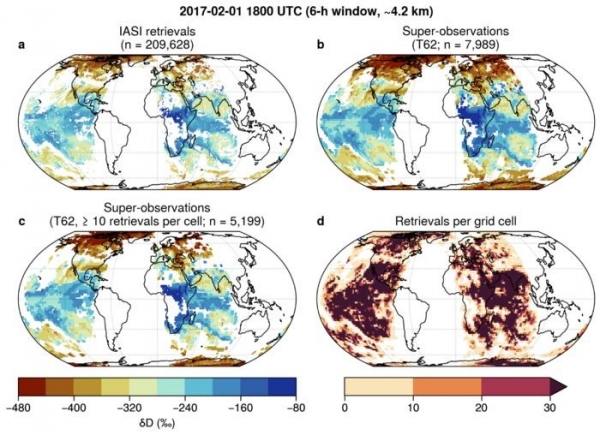
Image: The researchers combined many individual satellite observations collected over six hours into a single, high-quality measurement for each region. By filtering out areas with too little data, they created a reliable global dataset that could be fed directly into their weather forecasting model. ©2026 Yoshimura et al. CC-BY-ND


