

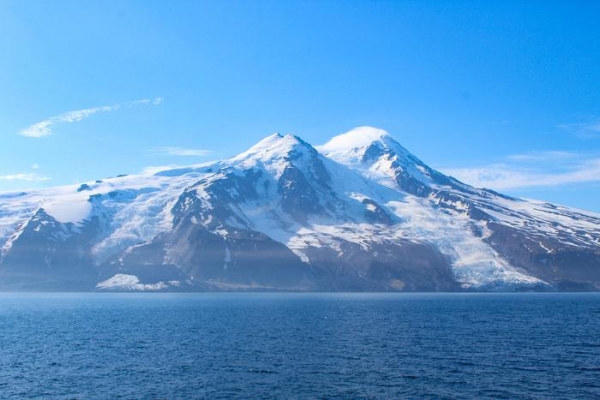
A strong earthquake near the Arctic island of Jan Mayen triggered a massive rock avalanche in March 2025.
A strong earthquake near the Arctic island of Jan Mayen triggered a massive rock avalanche in March 2025. The resulting debris buried part of the Kjerulf Glacier beneath rock and rubble. A study by researchers at the GEOMAR Helmholtz Centre for Ocean Research Kiel indicates that climate change likely played a crucial role in this event. Long-term warming and permafrost degradation weakened the rock, making it more susceptible to earthquake shaking. These findings highlight how natural hazards in polar regions are changing – with potential implications for glacier and permafrost areas worldwide. The study is published today in the Proceedings of the National Academy of Sciences (PNAS) journal.
‘Permafrost’ refers to permanently frozen ground. The rock is held together by ice, much like cement binds concrete. However, when the ice thaws, the ground becomes weak and unstable. During an earthquake, this can trigger a series of natural hazards. An international research team investigated precisely such an event. On 10 March 2025, an earthquake measuring 6.5 on the moment magnitude scale shook Jan Mayen Island, triggering a rock avalanche that covered part of a glacier with rock and debris mounds known as molards, located approximately 7 kilometres from the epicentre.
The researchers set out to understand why this particular earthquake caused such pronounced slope instability, even though the region has long been seismically active. Was there an additional factor that made the rock especially vulnerable? And what role does ongoing climate change play? Their findings are published today in Proceedings of the National Academy of Sciences (PNAS).
Read More: Helmholtz Centre for Ocean Research Kiel (GEOMAR)
Image: The same area after the rock avalanche triggered by a 6.5-magnitude earthquake: Large quantities of volcanic and permafrost debris tumbled down at the Kjerulf Glacier, spreading the material across the surface and covering the ice right up to the coast (left side oft he picture). (Photo Credit: Grace Angeli)


