

The work is part of a multiyear effort to develop a distributed sensor network for relaying data collected from this critical region.
The work is part of a multiyear effort to develop a distributed sensor network for relaying data collected from this critical region.
Beneath the Arctic Ocean is an orchestra featuring natural and human composers, from cracking sea ice and whistling beluga whales to humming shipping-vessel engines. Researchers from MIT Lincoln Laboratory heard some of this cacophony when analyzing data from commercial off-the-shelf sensors that they integrated and deployed in 2024 during the U.S. Navy's Operation Ice Camp (OIC). This past March, during OIC 2026, the researchers returned to the Arctic with a higher-fidelity version of one of the sensors, a geophone, which detects vibrations in the sea ice.
"We're interested in things that make sound underneath the ice," says Ben Evans, a researcher in the laboratory's Advanced Undersea Systems and Technology Group. "For example, our OIC 2024 data contained marine-mammal songs. We need a better understanding of how such signals propagate through ice, and how to distinguish these signals from other sources."
Read More: Massachusetts Institute of Technology (MIT)
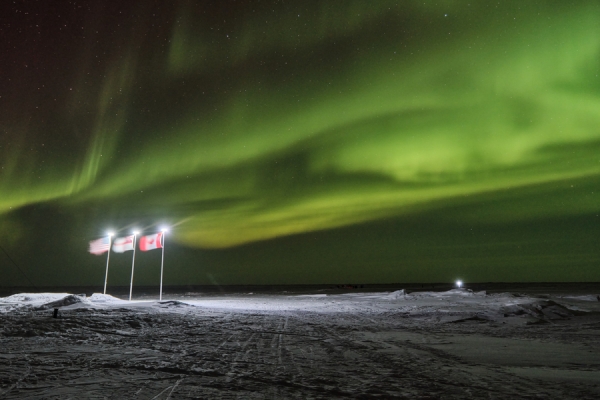
Image: Flags planted in the Arctic ice by countries participating in Operation Ice Camp 2026 wave in the wind against a backdrop of the northern lights. Credits: Photo: Ben Evans/Lincoln Laboratory


