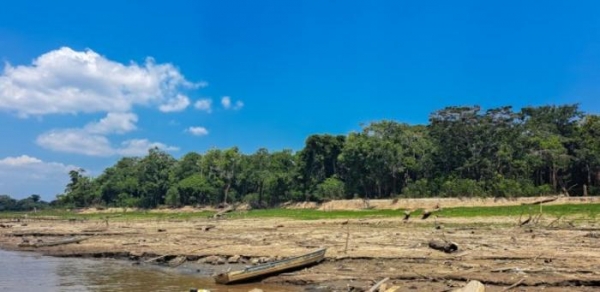
The historic droughts of 2023 and 2024 in the Amazon reduced river flows and altered the composition of rainfall in the region.
The historic droughts of 2023 and 2024 in the Amazon reduced river flows and altered the composition of rainfall in the region. Daily monitoring in Manaus, the capital of the Brazilian state of Amazonas, revealed this through the use of isotopes, which act as a kind of water “fingerprint.” This method demonstrated how El Niño and the warming of the North Atlantic affected the origin of moisture and the dynamics of precipitation.
Led by researchers from São Paulo State University (UNESP) in Brazil, the study suggests that isotopes can provide an early warning of prolonged droughts. This study is one of the first in over 30 years to utilize isotopic techniques in Amazonian hydroclimatic research.
Isotopes are lighter or heavier versions of atoms of the same chemical element. Water molecules (H₂O) are composed of hydrogen and oxygen atoms. Most hydrogen atoms have an atomic nucleus consisting of just one proton. However, the nuclei of a small fraction of them are twice as heavy and are composed of one proton and one neutron. Similarly, most oxygen nuclei have eight protons and eight neutrons, though some have nine or ten neutrons. Therefore, some water molecules are lighter and evaporate more easily, while heavier molecules condense first.
Read more at: Fundação de Amparo à Pesquisa do Estado de São Paulo
he banks of the Amazon River in Manaus receded due to a severe drought in October 2023 (Photo Credit: Rafaela Rogrigues Gomes)