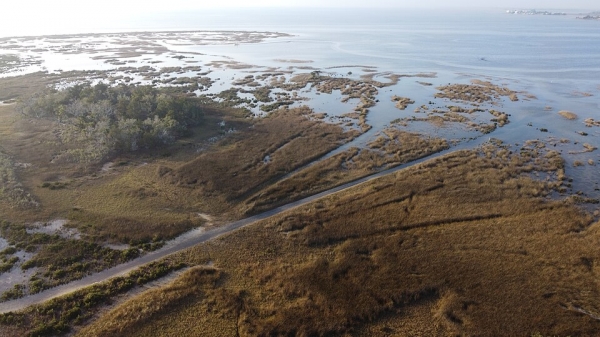
The first national-level assessment of coastal wetland submergence shows most of them may still be able to migrate inland, highlighting the need for strategic coastal management.
The first national-level assessment of coastal wetland submergence shows most of them may still be able to migrate inland, highlighting the need for strategic coastal management.
Along the three coasts of the contiguous United States, a silent race unfolds. Fueled by climate change, sea levels rise faster than at any time in recent geologic history. Meanwhile, coastal wetlands cling to a slim lead, lifted on newly accumulated sediments or moving inland as encroaching tides nip at their heels.
Now, the first national-level study of this competition reveals that coastal wetlands — among the country’s most valuable ecosystems, protecting infrastructure and providing homes for wildlife — are losing ground: 84% are gradually inundating, with many on track to transform into open water. Wetlands along the Gulf Coast are generally faring the worst while certain stretches of the Atlantic Coast appear more resilient. Some wetlands may be able to migrate inland or build up sediment fast enough to keep pace with sea level rise, perhaps with the right help from land managers.
“Our study provides wetland managers with new information to help them make better-informed decisions and identify meaningful solutions to issues they may be encountering, including to facilitate wetland migration upslope,” said Glenn Guntenspergen, a coastal wetland ecologist with the U.S. Geological Survey and senior author on the study.
Read More: American Geophysical Union
Photo Credit: Chastizement via Wikimedia Commons