Arctic sea ice moves and spreads in ways that wind alone cannot explain.
Arctic sea ice moves and spreads in ways that wind alone cannot explain. A new UC Riverside-led study finds that collisions between individual pieces of ice provide a surprisingly simple explanation for these movements, potentially offering scientists a better way to predict where sea ice will travel as the Arctic warms.
The study, published in Physical Review Letters, was led by Bryan Shaddy, formerly a UC Riverside undergraduate and now at the University of Southern California, with UCR materials scientist Alex Greaney and Bhargav Rallabandi, associate professor of mechanical engineering at UCR.
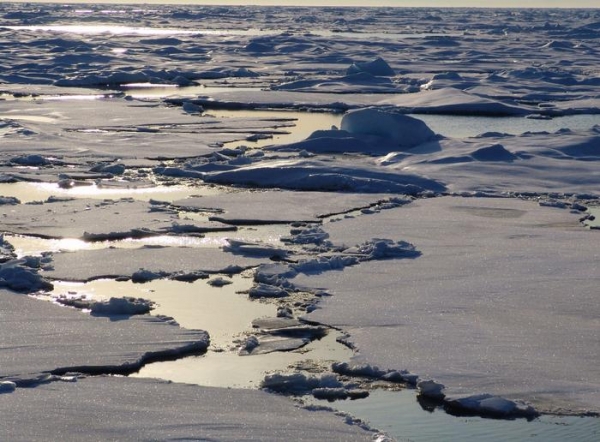
Arctic sea ice is not a single, continuous sheet. It consists of individual slabs, called floes, ranging from several meters to a few kilometers across. Winds push these floes across the ocean, causing them to drift and gradually spread apart.
Scientists know that wind is a major force moving Arctic sea ice. But the ice doesn’t behave the way the wind alone would suggest. The speed at which the ice moves varies in unexpected ways, and it spreads much more slowly than simple wind-driven models predict.
Read More: University of California - Riverside
Image: Ice floes coming together in the Arctic. (Credit: Pablo Clemente-Colon, Chief Scientist, National Ice Center, NOAA)