In 2021, MIT set campus decarbonization goals as part of its Fast Forward climate action plan.
In 2021, MIT set campus decarbonization goals as part of its Fast Forward climate action plan. Five years later, many of those goals have been met or are on track for completion, including efforts to make the Institute’s buildings more efficient, expand rooftop solar installations, and attain net-zero emissions.
“Decarbonizing our campus goes hand-in-hand with MIT’s playing a leadership role in promoting carbon reduction and climate resilience through its research, innovation, and efforts to inform public policy in this area,” says Glen Shor, executive vice president and treasurer. “Our teams are leveraging that same innovative spirit to meet our campus climate goals.”
Over the past decade, the Institute has decreased energy use per square foot by more than 10 percent, even as the campus has grown and research activity has intensified. Rooftop solar power generation has increased by more than five times in the same period, with installations added to the Stratton Student Center (Building W20), the Dewey Library (Building E53), the New Vassar undergraduate residence hall (Building W46), Graduate Junction (Buildings W87 and W88), and the theater arts building (Building W97). Thirty-three MIT building projects have earned Leadership in Energy and Environmental Design (LEED) certification. And in May, the Tina and Hamid Moghadam Building (Building 55) became MIT’s first Living Future Zero Carbon Certified building.
Read more at: Massachusetts Institute of Technology
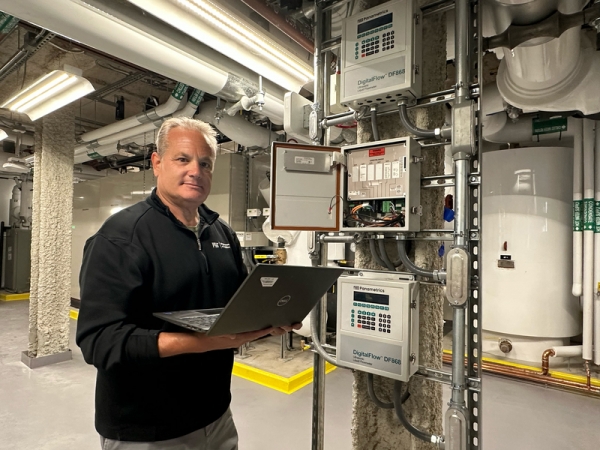
Fran Selvaggio, senior building management systems engineer in the MIT Department of Facilities, stands in the newly renovated Met Warehouse, where an innovative heat-recovery system captures heat rejected from the campus cooling system and uses electric heat pumps to generate heat for the building. (Photo Credit: Monica Lee)