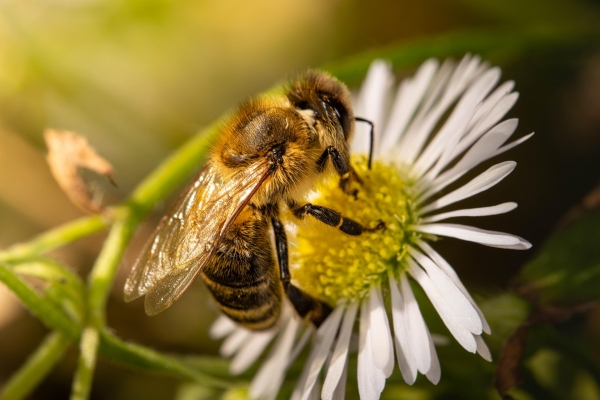
The research, published in the British Ecological Society’s Journal of Applied Ecology, has found that grazing in spring can remove much of the nectar emerging bumblebees need, while commercial honey bee hives introduced during the summer heather flowering period have a much smaller impact.
The research, published in the British Ecological Society’s Journal of Applied Ecology, has found that grazing in spring can remove much of the nectar emerging bumblebees need, while commercial honey bee hives introduced during the summer heather flowering period have a much smaller impact.
Commercial beekeepers across Europe regularly move hives onto heather moorland during the summer flowering of ling heather. This has raised concerns about competition between honey bees and wild pollinators, including bumblebees, butterflies, moths and beetles.
To find out the best way to protect them, researchers from Bristol’s School of Biological Sciences surveyed plant and pollinator communities at 20 moorland sites across Scotland over a full flowering season (May to September), comparing plots with and without introduced honey bee apiaries, and comparing land that was actively grazed and burned using ‘muirburn’ practices against land left to regenerate naturally.
Read More: University of Bristol
Photo Credit: Schnapp_schuss via Pixabay