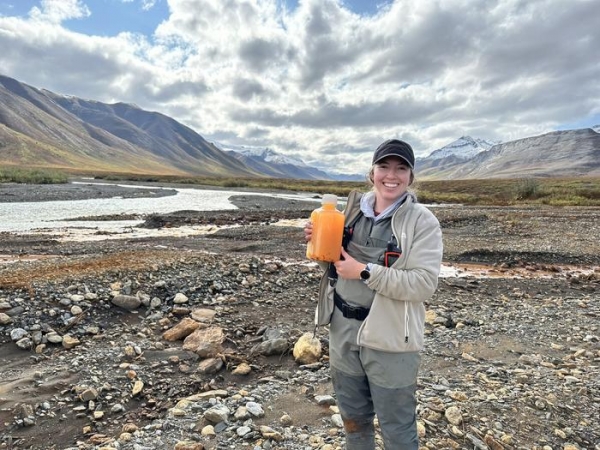
The bright orange plumes of water scientists first noticed billowing across a river in Alaska’s Brooks Range in 2018 were even more acidic and metallic than water leached from metal mines, despite their pristine surroundings.
The bright orange plumes of water scientists first noticed billowing across a river in Alaska’s Brooks Range in 2018 were even more acidic and metallic than water leached from metal mines, despite their pristine surroundings. That is according to a new study from the University of California, Davis, of six of the impacted watersheds.
The study, published in the journal AGU Advances, found that these metals can travel far and become more toxic as they go. Metal concentrations were about 70 times higher as much as 60 miles downstream from where they entered the river.
“This is very acidic, metallic water,” said senior author Brett Poulin, a UC Davis professor in the Environmental Toxicology department. “The good news is the river’s mainstem did not become more acidic. It’s buffering the pH, indicating there is some resiliency in this system. But there are metals that increased downstream, and those can be transported very long distances.”
Read More: University of California Davis
Taylor Evinger, a UC Davis Ph.D. candidate, holds a bottle of orange water sampled from the Igning River in Gates of the Arctic National Park and Preserve in Alaska. (Photo Credit: Courtesy Taylor Evinger/UC Davis)