Scientists used machine-learning and super-resolution microscopy to overcome a challenge that has stymied research into the natural history of grasses for decades.
Scientists used machine-learning and super-resolution microscopy to overcome a challenge that has stymied research into the natural history of grasses for decades. Their method allowed them to detect subtle differences among grass pollen grains and trace changes in grass diversity at one site over a period of 25,000 years.
“Open grasslands are a relatively recent ecosystem in Earth history, with open-habitat grasses present in the Eocene, about 40 million years ago,” the researchers wrote in a report in the Proceedings of the National Academy of Sciences. “Grasses were potentially the first plants domesticated about 12,000 years ago and today include several of the world’s most important staple foods, such as wheat, rice, maize, barley, sorghum and millet.”
But researchers face a massive challenge when trying to classify pollen fossils: grass pollens tend to all look alike, said University of Illinois Urbana-Champaign plant biology professor Surangi Punyasena, who led the new research with former Ph.D. student Marc-Élie Adaimé, now a postdoctoral researcher at the Smithsonian’s Office of Digital and Innovation.
Unlike pollen from other flowering plants, which can be distinguished by their shapes, spikes, grooves or pore arrangements, pollen grains from different grass species look remarkably similar under a standard light microscope.
Read More: University of Illinois at Urbana-Champaign
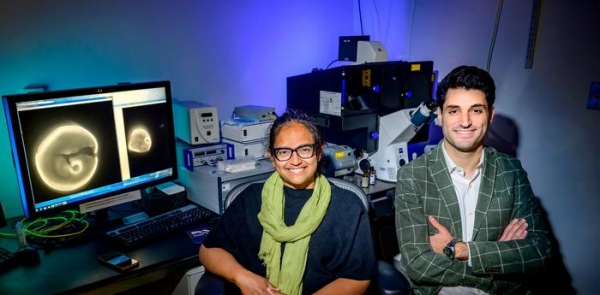
Image: Plant biology professor Surangi Punyasena, left, former U. of I. Ph.D. student Marc-Élie Adaimé and their colleagues developed deep-learning methods for establishing the composition and diversity of fossil grass pollen samples. Adaimé is now a postdoctoral researcher at the Smithsonian’s Office of Digital and Innovation. (Credit: Photo by Fred Zwicky)