

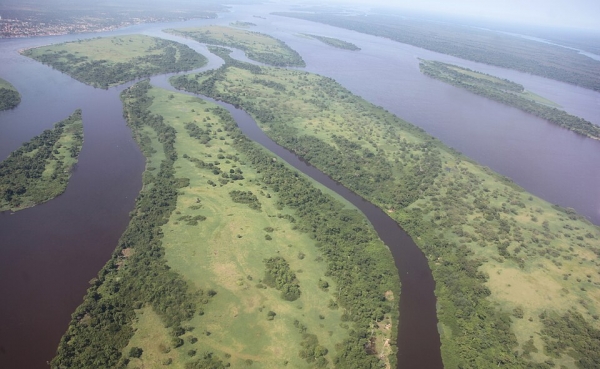
A team from the University of Lausanne has developed a new approach to better understand the carbon cycle in the Congo’s peatlands, one of our planet’s lungs.
A team from the University of Lausanne has developed a new approach to better understand the carbon cycle in the Congo’s peatlands, one of our planet’s lungs. The ratio between carbon captured and net oxygen production appears to be far more dynamic than previously thought, and the peatlands may be more sensitive to climate variability than previously believed.
The peatlands of the Congo Basin are gigantic natural carbon reservoirs. Today, these wetlands store nearly 30 billion tonnes of CO2, accumulated over thousands of years in the form of organic carbon. This is equivalent to the amount of CO2 humanity produces in three years. If the peatlands were to dry out, the resulting release of CO2 into the atmosphere could, on its own, jeopardise the goals of the Paris Agreement.
Yet several questions remain about how these ecosystems function. At the University of Lausanne (UNIL), scientists have shed new light on the carbon cycle in these environments. By studying a peat core spanning 10,600 years, they have shown that the ratio between CO2 uptake and oxygen release is neither stable nor balanced, as previously thought. Instead, it varies slightly depending on hydroclimatic conditions, particularly during wetter or drier periods. Their findings have been published in Nature Geoscience.
Read More: University of Lausanne
Photo Credit: MONUSCO/Myriam Asmani via Wikimedia Commons



