

URochester researchers use mathematical modeling to explore how wave-like soil patterns form—and what they could reveal about landscape stability.
URochester researchers use mathematical modeling to explore how wave-like soil patterns form—and what they could reveal about landscape stability.
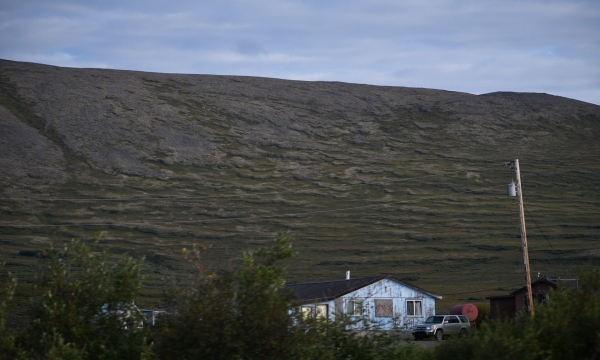
In some of Earth’s coldest places, soil freezes, thaws, and slowly creeps downhill, creating large, wave-like patterns across entire hillsides. The patterns resemble those made by familiar fluids—think paint dripping down a wall or icing down the side of a cake. But the physics behind those everyday materials can’t explain how the icy landscapes form.
So University of Rochester researchers went looking for a better comparison. They found one in an unlikely place: oobleck.
In a study published in AGU Advances, Rachel Glade, an assistant professor in the Departments of Earth and Environmental Sciences and Mechanical Engineering, and her URochester colleagues used mathematical modeling to compare how different fluids behave. Their analysis suggests that solifluction patterns—the ripples formed as frost-heaved, water-saturated soil slowly moves downhill—form through a process analogous to the unusual behavior of oobleck, a mixture of cornstarch and water that becomes harder to move the harder it’s pushed.
Read More: University of Rochester
Image: A HILL TO FREEZE-DRY ON: Wave patterns on hillslopes in some of the Earth’s coldest places, such as these seen in Nome, Alaska, form due to solifluction, a gradual process where soil freezes and heaves upward. (Photo: David Cúñez)


