

Researchers from the University of Osaka use artificial intelligence and nanotechnology to detect amino acid biosignatures.
Researchers from the University of Osaka use artificial intelligence and nanotechnology to detect amino acid biosignatures.
The truth is out there – but identifying signs of life in space involves an intense search for biosignatures within our solar system and beyond. However, developing sensitive, yet compact, technologies capable of detection has proven to be an out-of-this-world challenge.
However, this may be set to change, as researchers at the University of Osaka have developed an electrical method that could be used to detect extraterrestrial life. This exciting discovery is set to be published in Nature Communications.
Identifying both living beings and nonliving chemicals and processes relies on amino acids, the building blocks for proteins. Amino acids have the same chemical formula but possess two mirror image forms, capable of distinguishing the living from the nonliving. For living creatures, almost all amino acids are exclusively in the L-form, with sugars existing in the D-form. By contrast, nonliving chemical and physical processes produce both L- and D-forms in equal abundance.
Read More: The University of Osaka
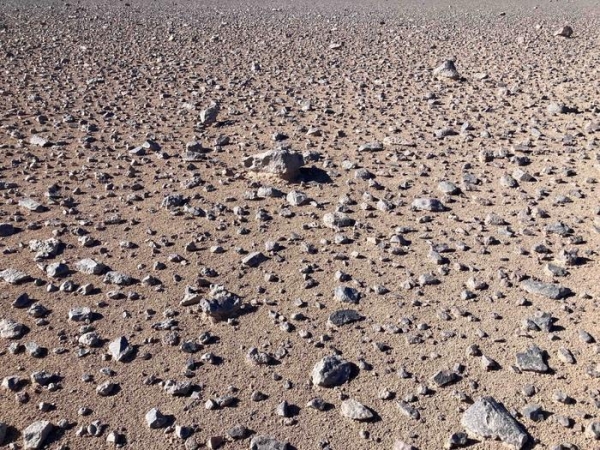
Image: The hyperarid core of the Atacama Desert at the North of Antofagasta (NOA) site, a Mars-analog environment where samples analyzed in this study were collected. (Credit: Christopher E. Carr)


