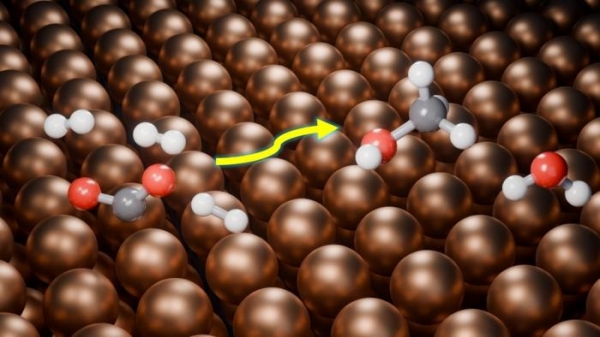
Scientists are increasingly exploring carbon dioxide (CO₂) hydrogenation – where CO₂ reacts with hydrogen over a catalyst to give rise to products like methanol – to convert CO₂ into useful chemicals and fuels.
Scientists are increasingly exploring carbon dioxide (CO₂) hydrogenation – where CO₂ reacts with hydrogen over a catalyst to give rise to products like methanol – to convert CO₂ into useful chemicals and fuels. However, it involves thousands of tiny chemical steps happening on the catalyst surface. To model these steps computationally, researchers traditionally select a relatively small number of likely reactions, because modeling every possible reaction using quantum mechanics is prohibitively expensive. But this means that hundreds of important reactions may be missed.
Researchers at the Indian Institute of Science (IISc) have now developed a data-driven computational framework that maps nearly 10,000 chemical reactions involved in converting CO₂ into fuels and chemicals on a copper catalyst. The approach could help scientists better understand and eventually design effective catalysts for turning CO₂ into chemicals and fuels. The study was published in Nature Communications.
“We began with a worry familiar to anyone who does mechanistic modelling: How do you know that your reaction network has not omitted the one step that matters?” says first author Anand Mohan Verma, who worked on the study as a CV Raman Postdoctoral Fellow at IISc and is currently an Assistant Professor at the Motilal Nehru National Institute of Technology Allahabad (MNNIT Allahabad).
The researchers first generated a carefully curated, extensive database of 152 reactions using quantum-mechanical simulations. Then, they trained machine learning models to rapidly predict activation energy barriers for additional reactions. In addition, they used automated tools to predict all possible reactions involving 105 surface species, and which of these would occur as single-step reactions. This allowed the researchers to expand the original network to 9,389 elementary reactions.
Read More: Indian Institute of Science
Image: Surface of a copper catalyst depicting CO2 hydrogenation to methanol (Credit: Shivam Chaturvedi)