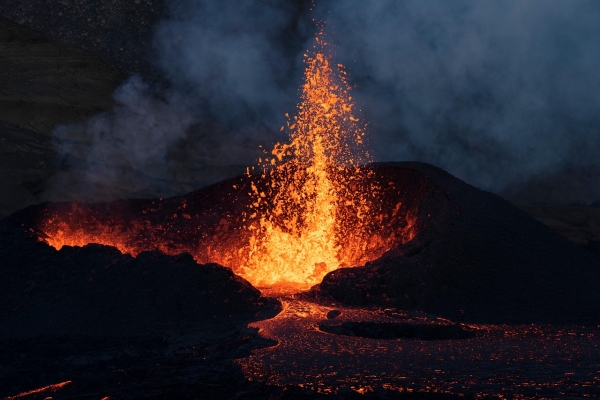
The magma reservoir of the largest volcano eruption of the Holocene is refilling.
The magma reservoir of the largest volcano eruption of the Holocene is refilling. This Kobe University insight on the Kikai caldera in Japan allows us to understand giant caldera volcanoes like Yellowstone or Toba more generally and gets us closer to predicting their behavior, too.
Some volcanoes erupt so violently, ejecting more magma than could cover all of Central Park 12 km deep, that all that’s left is just a wide and rather shallow crater, a so-called “caldera.” Examples of such supervolcanoes are the Yellowstone caldera, the Toba caldera and the mostly underwater Kikai caldera in Japan, which last erupted 7,300 years ago in what was the largest volcano eruption in the current geological epoch, the Holocene. We know that these volcanoes can and do reerupt but we know very little about the processes that lead up to an eruption and are therefore ill-equipped to make predictions. “We must understand how such large quantities of magma can accumulate to understand how giant caldera eruptions occur,” says Kobe University geophysicist SEAMA Nobukazu.
That the Kikai caldera is mostly underwater is, in fact, an advantage to tackle questions like this. Seama explains, “The underwater location allows us to implement systematic, large-scale surveys.” Thus, the Kobe University researcher teamed up with the Japan Agency for Marine-Earth Science and Technology (JAMSTEC) and used airgun arrays that cause artificial seismic pulses together with ocean bottom seismometers that listen to how that seismic wave propagates through the Earth’s crust to understand its condition.
Read More: Kobe University
Photo Credit: Gylfi via Pixabay