UFZ study combines climate and hydrological models to analyse flood peaks.
UFZ study combines climate and hydrological models to analyse flood peaks.
The extent to which anthropogenic climate change alters the intensity of individual extreme precipitation events can already be estimated reliably. However, the same cannot yet be said of the resulting flood hazards. A new study led by the Helmholtz Centre for Environmental Research (UFZ) found that climate change amplified flood peaks considerably more than precipitation itself during Storm Boris in 2024. Assessments based solely on precipitation may therefore lead to an underestimation of changes in flood hazards. The study was published in Science Advances.
In September 2024, Storm Boris brought extreme precipitation and severe flooding to large parts of Central and Eastern Europe. Poland, Czechia, and Austria were particularly affected. In some areas, several hundred millimetres of rain fell within a few days, and numerous rivers burst their banks.
Earlier attribution studies had shown that global warming intensified precipitation during Storm Boris. These studies compare the observed event with a counterfactual scenario that largely excludes human influence on the climate. However, such analyses generally stop at the meteorological event itself and focus on questions such as how much extreme precipitation has intensified. The effects of these changes on flood hazards therefore often remain unclear.
Read More: Helmholtz Centre for Environmental Research - UFZ
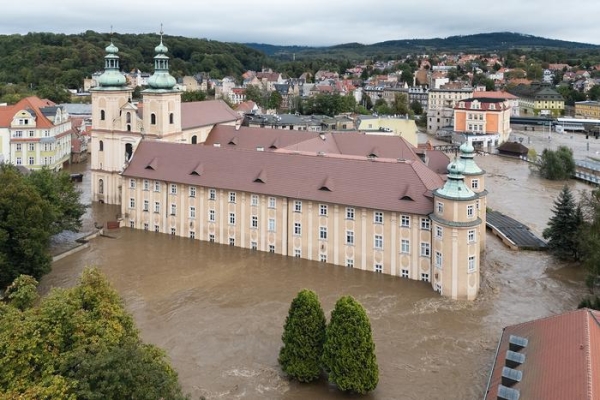
Image: Flooding in Kłodzko, Poland, in September 2024: the Nysa Kłodzka river floods the grounds of the Franciscan monastery. The region was hit particularly hard by the flooding after Storm Boris. (Credit: Jacek Halicki, CC BY-SA 4.0)