The Southern Ocean may seem far removed from the North Pacific or the Gulf of Maine, but its waters are linked to all the world's major ocean basins through a vast circulation system.
The Southern Ocean may seem far removed from the North Pacific or the Gulf of Maine, but its waters are linked to all the world's major ocean basins through a vast circulation system. Driven by powerful winds and currents, deep waters in the Southern Ocean rise toward the surface, where winter mixing helps form distinct water masses. Some of this water is then drawn back beneath the surface, or subducted, beginning a multidecade journey northward toward the equator and beyond. Along the way, these waters carry and recycle essential nutrients, helping shape phytoplankton communities across the global ocean.
A new study led by scientists at Bigelow Laboratory for Ocean Sciences examines how two major Southern Ocean water masses recycle nutrients during this decades-long journey. Published in the Journal of Geophysical Research: Oceans, the study tracks changes in the physical, biogeochemical, and optical properties of Subantarctic Mode Water (SAMW) and Antarctic Intermediate Water (AAIW). The findings offer a closer look at an enormous global circulation system and reveal how the two water masses follow distinct nutrient recycling pathways, potentially influencing the composition and productivity of far-reaching phytoplankton communities.
“When you integrate this water around the globe, the nutrient regeneration in Subantarctic Mode Water and Antarctic Intermediate Water supports about three-quarters of the primary production on Earth north of the 30th parallel south,” said Barney Balch, the study's lead author and senior research scientist emeritus at Bigelow Laboratory for Ocean Sciences. “This paper offers an in-depth glance at a very large global ‘windmill’.”
Read More at: Bigelow Laboratory for Ocean Sciences
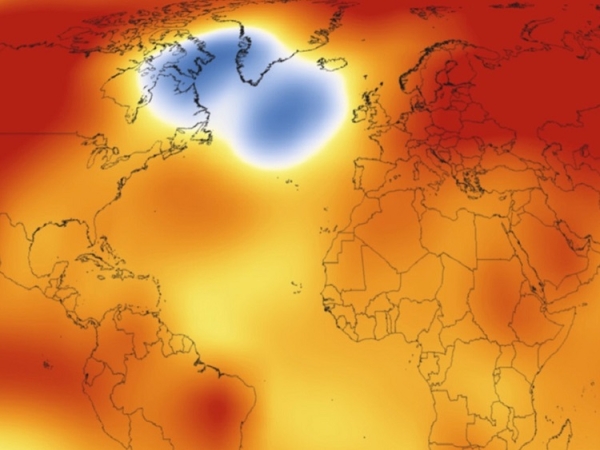
The 965,000-square-mile area in the North Atlantic Ocean south and southeast of Greenland, the so-called cold blob, cooled by as much 1.8 degrees Fahrenheit over the past century as other ocean waters warmed. (Photo Credit: NASA)