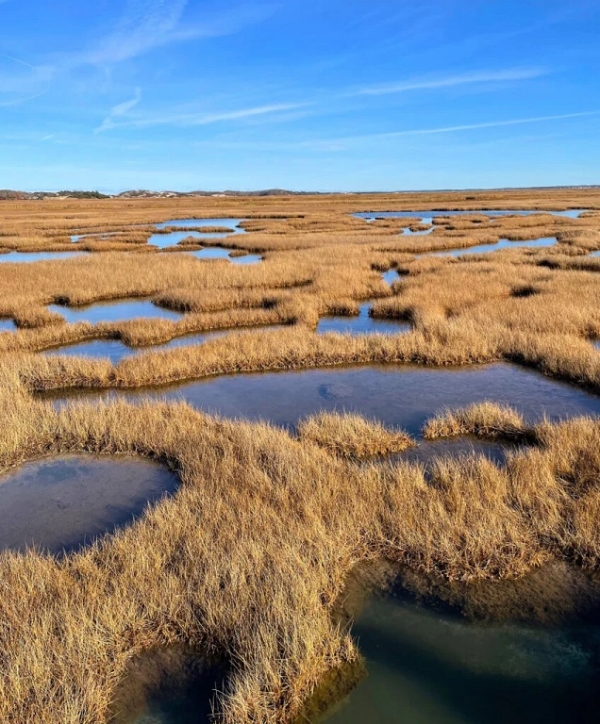
Coastal wetlands, like salt marshes, keep pace with sea-level rise by accumulating sediment and burying organic carbon in their soils, an important natural process that also helps sequester carbon.
Coastal wetlands, like salt marshes, keep pace with sea-level rise by accumulating sediment and burying organic carbon in their soils, an important natural process that also helps sequester carbon. Accurately measuring this stored carbon is essential for understanding marsh resilience and informing blue carbon strategies.
But a new study led by Erin Peck, an assistant professor at the University of Rhode Island’s Graduate School of Oceanography, and Serina Wittyngham, an assistant professor at the University of North Florida, identifies a fundamental limitation in a widely-used method for measuring organic carbon in flooded coastal sediments. This gap has implications for global estimates of carbon storage and marsh resilience.
Traditional blue carbon methods assume that all measured organic matter contributes to long-term carbon storage and sediment volume. The new study shows this isn’t always the case. Some organic matter is dissolved in sediment porewater, while other portions adhere loosely to sediment particles or are bound within the internal structure of clay minerals. These forms of organic matter may not contribute to sediment volume, accretion, or marsh resilience.
Read More: University of Rhode Island
A new study finds a critical limitation in a widely used method for measuring organic carbon in flooded coastal sediments, a gap that could influence global carbon storage estimates and assessments of marsh resilience. (Photo Credit: Erin Peck)