

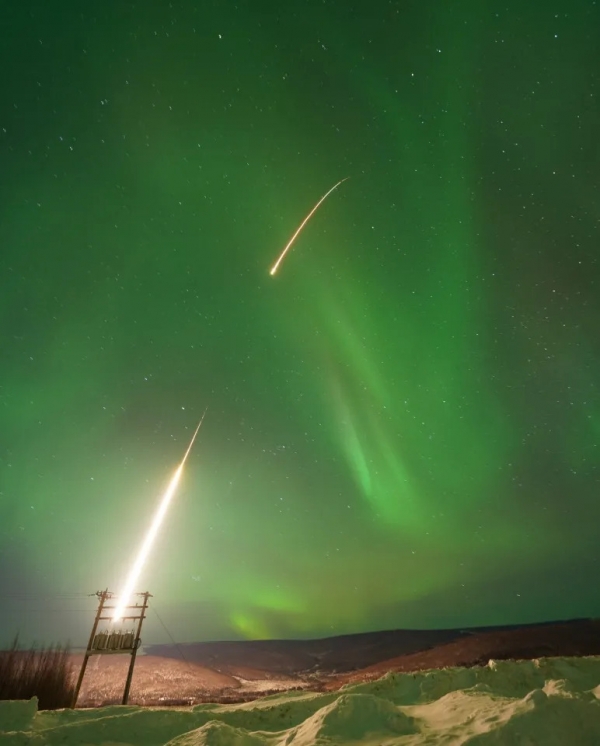
NASA’s Black and Diffuse Auroral Science Surveyor and Geophysical Non-Equilibrium Ionospheric System Science (GNEISS) sounding rocket missions have both successfully launched from Alaska.
NASA’s Black and Diffuse Auroral Science Surveyor and Geophysical Non-Equilibrium Ionospheric System Science (GNEISS) sounding rocket missions have both successfully launched from Alaska.
The Black and Diffuse Auroral Science Surveyor mission launched Feb. 9 at 3:29 a.m. AKST (7:29 a.m. EST), reaching a peak altitude of about 224 miles (360 kilometers). Principal investigator Marilia Samara said all instruments, including technology demonstrations, performed as expected and that the mission returned high-quality data.
The two-rocket GNEISS mission launched back-to-back on Feb. 10 at 1:19:00 a.m. and 1:19:30 a.m. AKST (5:19:00 a.m. and 5:19:30 a.m. EST). The rockets reached peak altitudes of approximately 198.3 miles (319.06 kilometers) and 198.8 miles (319.94 kilometers), respectively. Principal investigator Kristina Lynch reported that all ground stations, subpayloads, and booms functioned as expected and that the science team is pleased with both the launch and the data collected so far.
Read More: NASA’s Goddard Space Flight Center
Image: A long exposure shot of the Black and Diffuse Auroral Science Surveyor sounding rocket launch. The two bright streaks show the firing of the first stage and second stage motors as the rocket is propelled into the aurora. (Credit: Craig Heinselman, University of Alaska, Fairbanks/Geophysical Institute)


