

The Expanse supercomputer at the San Diego Supercomputer Center (SDSC) at the University of California School of Computing, Information and Data Sciences has played an important role in helping researchers design the next generation of batteries that could make large‑scale energy storage cheaper and more sustainable. T
The Expanse supercomputer at the San Diego Supercomputer Center (SDSC) at the University of California School of Computing, Information and Data Sciences has played an important role in helping researchers design the next generation of batteries that could make large‑scale energy storage cheaper and more sustainable. Today’s grid and electric vehicles rely heavily on lithium‑ion batteries, but lithium is relatively expensive and unevenly distributed globally. Sodium, by contrast, is abundant and inexpensive — the same element found in table salt — which makes sodium‑based batteries an appealing option for big battery installations that back up solar and wind power. The challenge has been getting sodium batteries to deliver enough power while also lasting for many charge–discharge cycles.
In this new study, scientists from UC San Diego worked with international colleagues to better understand the battery’s positive electrode, known as the cathode. They started from an existing sodium‑based material and experimented with adding very small amounts of lithium and titanium, like adjusting the seasoning in a recipe.
Read more at: University of California San Diego
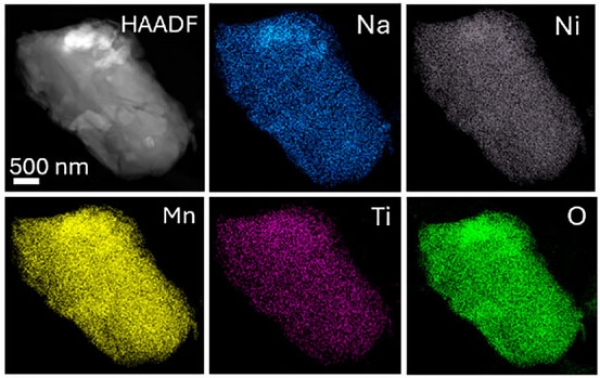
X-ray map showing how sodium, nickel, manganese, titanium and oxygen are spread throughout the new battery material proposed in the UC San Diego study that utilized SDSC’s Expanse. (Photo Credit: Advanced Energy Materials)


