

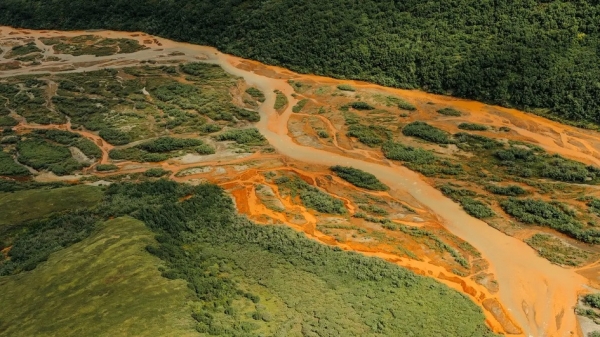
When ecologist Patrick Sullivan flew into the Salmon River in Alaska to conduct a vegetation study in the summer of 2019, he was excited about paddling down the pristine Arctic river. Before he and his colleague got there, however, the pilot warned that they might not see what John McPhee had described, in his best-selling book Coming Into the Country, as the “purest water I have ever seen.”
When ecologist Patrick Sullivan flew into the Salmon River in Alaska to conduct a vegetation study in the summer of 2019, he was excited about paddling down the pristine Arctic river. Before he and his colleague got there, however, the pilot warned that they might not see what John McPhee had described, in his best-selling book Coming Into the Country, as the “purest water I have ever seen.”
Even then, Sullivan was not prepared for the river that eventually came into view. For as far as the eye could see, the water flowed bright orange. Research would later reveal that it was too toxic for fish, most other forms of aquatic life, and shoreline vegetation to survive.
“It was a shock,” Sullivan recalls. “The pilot told us that [the river] was clear the year before. And we have photographic evidence that shows that it was clear in 2017.”
Read More at: Yale Environment 360
Tukpahlearick Creek in northern Alaska has turned rust-colored. (Photo Credit: Taylor Roades)


