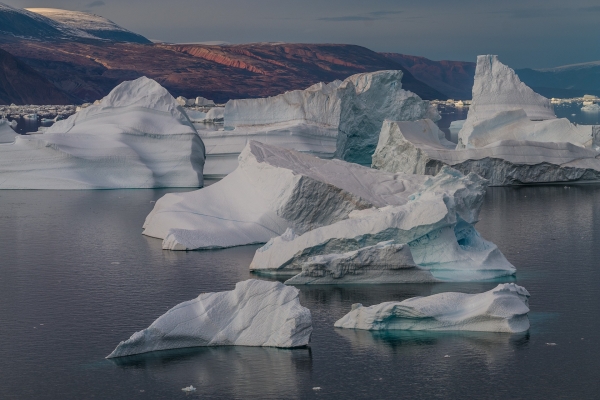
In Greenland, where the island’s ice sheet is melting around six times faster than it was in the 1990s, billions of tons of ice are already disappearing each year.
In Greenland, where the island’s ice sheet is melting around six times faster than it was in the 1990s, billions of tons of ice are already disappearing each year. Two new studies published in January focus on the role of algal blooms and their exacerbating effect on glacier and ice sheet melt in the Arctic. The first, led by Jenine McCutcheon, a geomicrobiologist at the University of Waterloo in Canada, analyzed the biogeochemical characteristics of the dust that is deposited on ice surfaces and how it contributes to melting. In the second study, led by Beatriz Gill Olivas, a postdoctoral researcher in the Department of Environmental Science at Aarhus University in Denmark, the authors investigated whether algal growth is limited by the availability of nutrients trapped in surface ice.
Despite popular conceptions of the icy surfaces in Greenland as being white and sterile, these sites are thriving ecosystems, inhabited by a variety of algae, fungi and other microscopic organisms. Processes like aerosol deposition and deglaciation cause nutrients to accumulate on the icy surfaces, feeding algae and causing algal blooms. These algal blooms form dark, brownish-gray spots on ice sheets and glaciers that reduce albedo, the property of a surface to reflect solar radiation. Any surface with an albedo level less than 100%—essentially any surface that is not a highly reflective mirror—will absorb small amounts of heat. As a result, high albedo slows down warming and low albedo increases warming.
Read More at: Columbia Climate School
Photo Credit: mariohagen via Pixabay